beyond the refresh cycle: getting network timing right
It is a common scenario across enterprise IT: the blinking green lights on your switches look steady, packet drops remain minimal, and user complaints are relatively quiet. Because the network still works, postponing a hardware refresh feels like a sensible financial decision that preserves capital for different projects.
But under that surface stability lies what infrastructure strategists call the lifecycle trap. Infrastructure can remain technically operational while quietly becoming harder to secure, expensive to maintain, and completely disconnected from modern business demands. Postponing modernization rarely keeps budgets flat; it steadily accumulates technical debt and exposes the entire organization to unmanaged business risk.
Here’s a closer look at what holding off really costs, why the status quo is riskier than it looks, and how to build a lifecycle plan that puts you back in control.
the hidden risk of an aging network
Legacy switches, access points, and routers rarely fail overnight in a catastrophic burst. Instead, they degrade by subtraction: security patcheseventually stop, vendor support windows expire, and subtle compatibility bottlenecks emerge across branch offices and data centers.
Keeping old hardware running also introduces operational blind spots. When monitoring legacy gear, engineering teams must rely on fragmented, manual troubleshooting rather than automated monitoring. What appears to be an efficient, fully amortized asset is often a fragile environment propped up by custom configurations and unpatched vulnerabilities.
modern workloads are raising the bar
Refreshing your network means aligning with modern connectivity models, far beyond a simple speed upgrade. Today’s applications demand levels of throughput, automated policy enforcement, and low latency that legacy architectures were never engineered to support.
We see major vendors raising the bar in four main areas:
AI-ready high-bandwidth fabrics: deploying modern AI workloads turns Ethernet into a core strategic asset. These environments demand low-latency, high-throughput switching fabrics designed to eliminate packet loss and avoid tail-latency bottlenecks during massive parallel computations.
Wi-Fi 7 and dense wireless environments: Wireless is transitioning toward true wired-equivalent performance. Enterprise adoption of Wi-Fi 7 is accelerating as organizations modernize infrastructures to handle dense video traffic, rich collaboration tools, and cloud workloads over the 6 GHz spectrum.
Automated and AI-driven operations: Leading vendors like Cisco, HPE, and Dell are introducing centralized management platforms that run automated configuration, root-cause analysis, and agentic workflows. These tools eliminate manual CLI maintenance and resolve network anomalies before end users experience disruption.
Post-quantum ready infrastructures: Modernizing now gives organizations a clear path to protect against “harvest now, decrypt later” risks. Modern gear, including Cisco’s latest Catalyst family and security appliances from Palo Alto and Fortinet, already integrates post-quantum cryptography straight out of the box.
Falling behind on these standards does not just mean missing out on incremental performance improvements. It actively limits your organization's agility, preventing teams from deploying modern tools and leaving environments congested and at risk.
what waiting really costs
The argument for postponing a network upgrade usually assumes that keeping legacy hardware costs zero dollars. In reality, holding off on hardware investment quietly inflates day-to-day operating expenses:
Mounting security and compliance exposure: Unsupported systems stop receiving patches, accumulating unaddressed vulnerabilities that invite breaches, failed audits, and stiff compliance penalties.
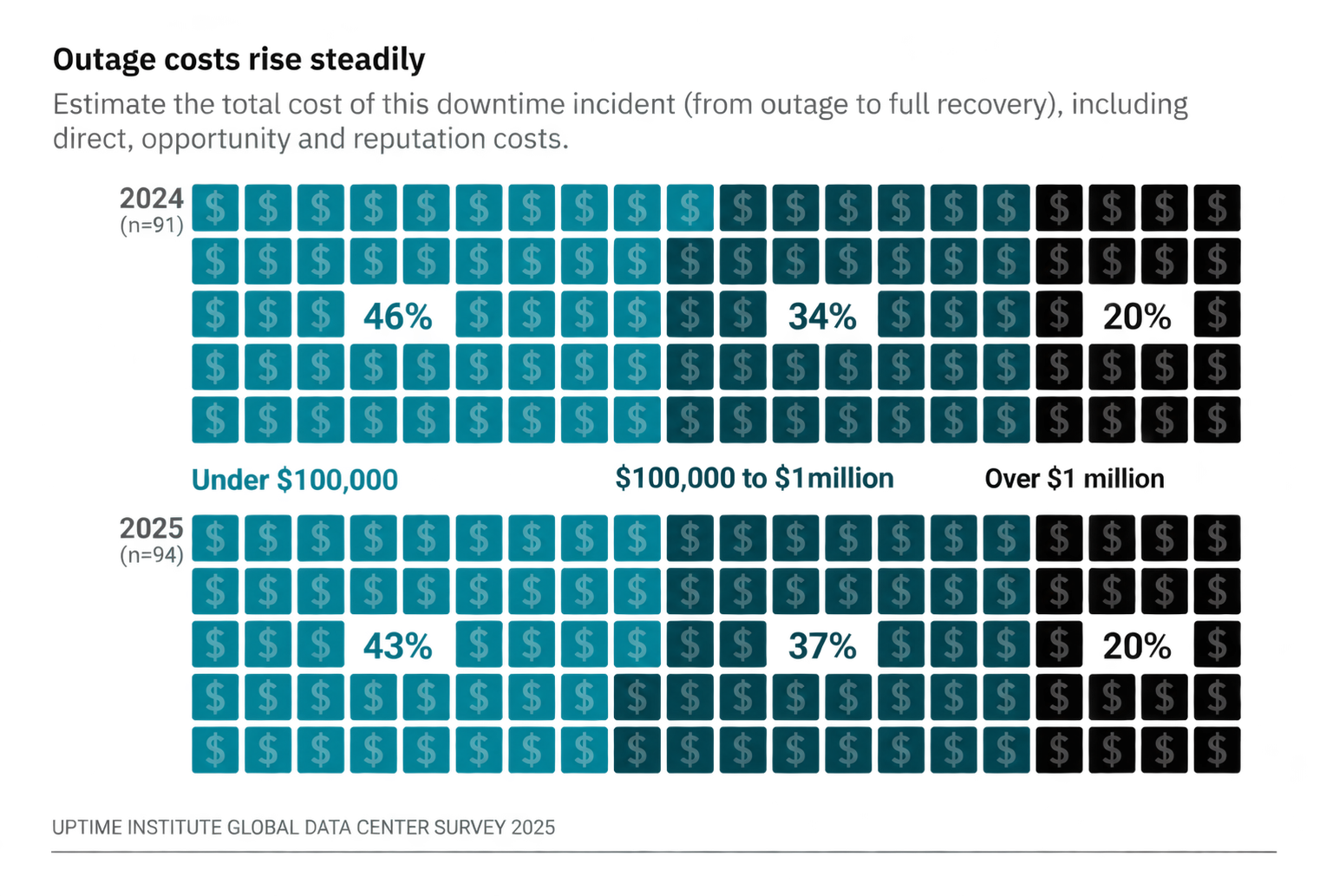
Costly downtime and outages: Aging hardware carries higher failure rates, triggering unplanned outages that can cost your company a lot of money
Source: Uptime institute study
Bloated maintenance overhead: Keeping legacy gear on life support forces teams into premium third-party contracts, scarce replacement parts, and endless manual troubleshooting.
Blocked business initiatives: Legacy networks simply lack the throughput, automation, and API support needed to roll out AI tools, new branch locations, or cloud services.
finding the right moment to modernize
Escaping the lifecycle trap does not mean replacing every piece of networking gear the moment a newer version hits the market. Rushing into immediate adoption can introduce immature firmware, unnecessary cost premiums, and avoidable operational friction.
True modernization is about alignment rather than technology fashion:
Prioritize business criticality: map your infrastructure inventory against operational value. Upgrade core data center fabrics, critical distribution nodes, and vulnerable perimeter gateways first, while scheduling non-critical access layers for later phases.
Avoid the migration cliff: waiting until months before a critical EoS milestone leaves zero margin for error. Global logistics bottlenecks, procurement lead times, and complex configuration migrations turn last-minute refreshes into stressful and rushed network upgrades.
Challenge pricing assumptions: new hardware does not automatically carry a prohibitive price tag. Manufacturers frequently price newer generations competitively against older product lines, offering higher port densities, superior energy efficiency, and bundled software licensing that reduce lifetime running costs.
from refresh deadlines to lifecycle control
Moving from frantic, reactive refreshes to predictable, continuous lifecycle management requires consistent operational oversight and Technology Asset Intelligence (TAI).
Good news, this is where Exellyn bridges the gap: we help multinational enterprises transform infrastructure lifecycle management into an ongoing competitive advantage.
Combining global reach with local touch, we serve as your true single point of contact for all your infrastructure and deployment needs across more than 110 countries.
Our teams support your entire technology journey:
Centralized sourcing and procurement: streamlining hardware acquisition and multi-vendor agreements to eliminate procurement headaches.
Standardized global deployment: rolling out data center configurations with consistent quality across all your operating locations.
Proactive maintenance and asset intelligence: monitoring lifecycle milestones and support contracts to ensure you modernize when it delivers maximum value, not when forced by an outage.
Certified asset disposition (ITAD): Managing secure on-site de-installation, certified data erasure, and circular remarketing or recycling to close the loop on retired assets sustainably.
By replacing the uncertainty of aging infrastructure with structured, predictable planning, we ensure your network remains secure, resilient, and ready for whatever workload comes next.
If you would like to see what a pragmatic, business‑driven modernization roadmap looks like for your environment, reach out today!
FAQs
The clearest indicators include rising maintenance and support contract renewal fees, difficulty sourcing replacement parts, frequent manual troubleshooting by senior engineers, lack of manufacturer security patches (EoL/EoS status), and an inability to support modern workloads like automated ZTNA or AI-driven tooling.
Not every switch needs to be replaced immediately upon reaching a target date. The risk depends on business criticality, network placement, and security exposure. If non-critical edge equipment is properly isolated and has accessible spare parts, extending its service life can be viable. However, deferring refreshes on core, perimeter, or customer-facing infrastructure creates severe security and operational exposure.
While legacy hardware carries no initial capital cost, its operational expenditure escalates rapidly due to custom support agreements, emergency repair fees, and manual maintenance. Modern platforms often offer higher port densities, lower power consumption, centralized cloud management, and automated troubleshooting, which lower long-term operating costs and reduce expensive outage risks.
Organizations should establish accurate Technology Asset Intelligence (TAI) to track all hardware, firmware versions, support contracts, and lifecycle milestones in a unified view. From there, IT leaders can establish a rolling 3- to 5-year roadmap that prioritizes phased upgrades based on business impact, avoiding last-minute migration cliffs.
A global lifecycle partner acts as a single point of contact to coordinate sourcing, configuration, multi-site logistics, day-to-day support, and certified IT Asset Disposition (ITAD). This eliminates the complexity of managing dozens of local vendors, ensuring standardized deployments and consistent security posture across all global offices.
Published
September 9, 2026
stay tuned!
Enjoying this article? Follow expert insights, industry trends, and more in our quarterly newsletter!